Worlds Adrift: physics-based sandbox MMO of player-built skyships
Worlds Adrift, developed by Bossa Studios, is a physics-driven sandbox role-playing MMO that cast players as Travellers building skyships to explore a shattered archipelago of floating islands. The game used SpatialOS to host a persistent, large-scale multiplayer world where player actions carried lasting consequences. Core systems included modular ship construction, a grappling-hook and glider traversal kit, and physics applied to every object. It aimed at sandbox MMO fans, creative builders, and players drawn to emergent exploration.
The game places you in a persistent, skybound sandbox with player-shaped consequence
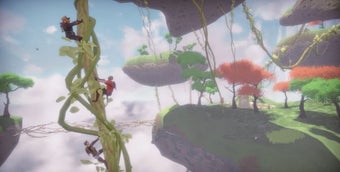
In this game you navigate a world composed of thousands of floating islands served by a SpatialOS-backed server architecture, which kept the world persistent and allowed actions to alter the environment. The persistent map was entirely community-crafted, so exploration rewarded players with unique, player-made locales. The core loop encouraged travel between islands, resource extraction, and experimentation with emergent interactions rather than fixed quest rails.
Modular ship construction and physics turn design into a mechanical challenge
In this game modular assembly dictated performance: component placement, material weight, and engine positioning changed flight handling and durability. Ship-building was not cosmetic, it was mechanical; engines, hulls, and load distribution affected momentum and control. Players gathered resources and used crafting systems to upgrade components, so progression tied directly to the quality of parts and the player’s engineering choices.
Unscripted encounters arise from physics-first movement and systems
In this game traversal tools produced emergent moments: a grappling hook and glider system let players swing between islands and influence momentum, while real-time physics applied to every object influenced combat and environmental interactions. The design moved away from class roles toward improvisation, so player skill with momentum and ship control shaped success in exploration and conflict.
Technical ambition affected accessibility and stability for players
In this game the scale and realtime physics demanded a capable PC, with minimum requirements that included an Intel Core i5-2500K or equivalent and 8GB RAM. That ambition created pressure on performance and stability, and critics noted technical instability linked to the large persistent simulation. Those engineering demands also strained the studio’s ability to sustain the live infrastructure over time.
The game is an instructive, ambitious experiment now best approached as a preserved design case
The game is a notable example for players who enjoy physics-driven, player-led sandbox design, but it no longer functions as a live MMO because official servers closed on July 26, 2019. For creators and designers, the standalone Island Creator remains available as a way to explore the worldbuilding systems; as a multiplayer destination the title is now a historical, instructive reference rather than an active service.
.png)